

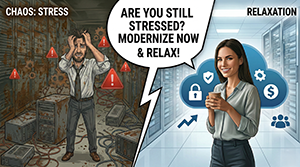
II recently received a customer request for a standard Citrix review—a review that I ultimately rejected. When I received the details, my first step, as always, was to review the key information: licenses, products, and components. The client’s goal was to update the environment. The wish list included Windows Server 2025, Teams, Office 365 with OneDrive as well as the introduction of FSLogix. The plan was to take risks In-place upgrades for the SQL and Provisioning Services (PVS) servers. In addition, the environment supports a maximum of 300 concurrent users (CCU) – a scale at which PVS is simply the wrong choice of technology.
Managed by just a single part-time Citrix administrator, they managed to get by clinging desperately to the complex old system out of sheer habit.
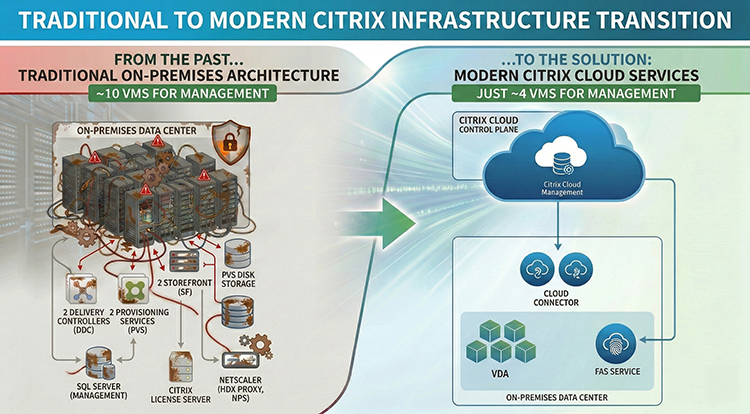
The old infrastructure:
- 2x Delivery Controller (DDC)
- 2x Provisioning Services (PVS)
- 2 StoreFront servers
- NetScaler (HDX Proxy + NPS for MFA)
- Citrix License Server
- SQL Server
Does this sound familiar to you?
Then came the turning point: I realized that the customer was already using Citrix Universal Hybrid Multi-Cloud (UMHC)-holds licenses.
That was exactly the point at which I refused to conduct the review as requested. Why? Because clinging to that level of redundant complexity means living in the past. For an IT services firm looking to bill for hours, that’s a dream; for an efficient IT operation, however, it’s a nightmare.
Instead of simply replicating the old design, I recommended switching to Citrix DaaS with Machine Creation Services (MCS) and Citrix UPM, based entirely on ProfileDisk. I showed the admin exactly how this approach would drastically simplify his daily work while simultaneously massively reducing the required on-prem resources. However, before he could accept the new design, he expressed serious concerns about moving the VDAs to the cloud—something I had to address immediately.
Clearing Up the „Cloud“ Misconception
When customers hear „Citrix Cloud,“ they often immediately worry that their data or VDAs are hosted on Azure or AWS. They ask, „How do we connect to our on-premises database if the VDAs are in the cloud?“ The term „cloud“ is often a stumbling block here; „Citrix Cloud Services“ would be much more accurate. The admin was visibly relieved when he realized that the workers, corporate data, and user connections remain entirely on-premises.
The admin openly admitted to having zero experience with MCS or the cloud, and clearly showed fear of the unknown. In the end, it was the drastic simplification brought about by the new design that convinced him to modernize.
The new architecture:
Two cloud connectors
- Two Federated Authentication Service (FAS) services as a shared workload
- Machine Creation Services (MCS) instead of Provisioning Services
- User Profile Management (UPM) ProfileDisk instead of FSLogix
- Gateway Service instead of NetScaler + Network Policy Server
- SQL Database and Licenses as a Service in Citrix Cloud
The outcome and value of the license
- 60 fewer infrastructure VMs (%): The traditional environment required at least 10 management systems. The new architecture requires only 4 (2 Cloud Connectors, 2 FAS units).
- Put an end to the upgrade madness: The release cycles for Long-Term Service Releases (LTSR) have become noticeably shorter. Those who remain on-premises are forced to deal with increasingly frequent and time-consuming version upgrades for Delivery Controller, StoreFront, Provisioning Services, and SQL Server. If you use cloud services, this effort is completely eliminated. The regular nail-biting wait for monthly Windows updates for these essential infrastructure components is also a thing of the past.
- True Return on Investment (ROI): The UMHC license has already been paid for and includes cloud services. Anyone who stubbornly clings to a purely on-premises architecture with this licensing model is wasting money twice over: The paid cloud features remain unused, while at the same time costs are incurred for compute, storage, backup, Windows Server licenses, and the operation of six redundant servers.
- Drastic simplification of operations: The Cloud Connectors update themselves. There is no longer a need to constantly install NetScaler firmware upgrades to address critical security vulnerabilities. Manual disk management of the PVS servers is no longer required; instead, image management is handled simply and directly through Machine Creation Services.
How about you? Still stuck in the past and afraid of change? It's time to modernize and simplify!

 German
  English